
Executive Report:
Navigating The AI/SI Search Shift Through Canonical Identity Theory And Trust Engineering
Part 1. The Macro Shift: From Keyword Search to AI/SI Decision Makers
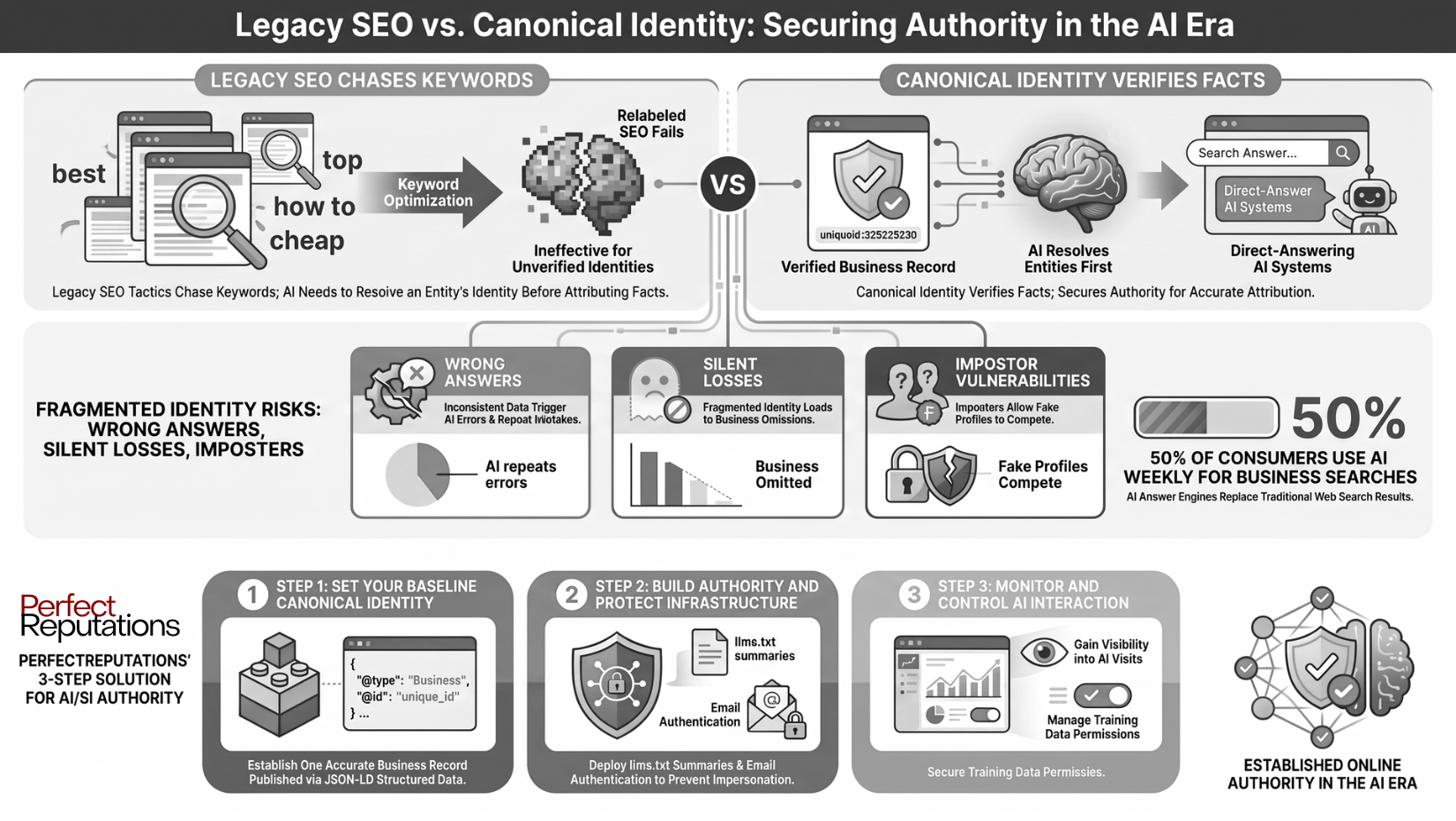
The enterprise digital landscape is undergoing a fundamental structural transition: moving from classical web search retrieval to Artificial Intelligence and Superintelligence (AI/SI) resolution systems.
Classical web search operated strictly as a retrieval and ranking mechanism. Users submitted string queries, and search engines matched keywords against an index of web pages. Candidate pages were then ranked using relevance algorithms, keyword density, and link graph authority. Under this legacy paradigm, the web page functioned as the primary unit of visibility, while the keyword served as the primary unit of user intent.
In contrast, modern AI/SI systems act as synthesized resolution engines, or “oracles.” When a user queries an AI/SI system for business recommendations, vendor selections, or corporate evaluations, the system does not return a ranked list of hyperlinked candidates for human sorting. Instead, it directly composes an answer. To generate this response, the AI/SI system must first resolve the underlying entities, evaluate the credibility of known assertions, judge its own internal confidence, and synthesize a factual response. Consequently, the fundamental unit of online visibility has shifted from the web page to the machine-resolvable entity.
Key 2026 Market Metrics
- 50% of Business Searches Controlled by AI/SI: Artificial Intelligence and Superintelligence systems now govern half of all consumer business searches (Data Axle, 2026).
- Weekly Consumer Adoption: Approximately half of all consumers utilize AI systems on a weekly basis to discover local businesses (Data Axle, 2026).
- 3× Acceleration in AI Shoppers: The proportion of shoppers starting their purchasing journeys via AI assistants has tripled year-over-year (Salesforce Consumer Research, 2026).
- 66% Friction Rate Due to Stale Information: 66% of consumers report attempting to visit or engage a business only to find its online information was completely inaccurate (Data Axle, 2026).
- Nearly $1B Lost to Business Impersonation: Consumers suffered nearly $1 billion in financial losses due to business impersonators in 2025 (Federal Trade Commission, 2026).
Business Risks of Unresolved Identity
Failing to adapt entity governance structures to meet the requirements of AI/SI resolution systems exposes enterprises to three severe operational risks:
- Wrong Answers (Propagation of Stale Data): When entity data diverges across public records, registries, and digital touchpoints, AI/SI systems ingest stale or contradictory assertions. The engine subsequently propagates incorrect physical addresses, outdated contact numbers, or invalid operating parameters, directly misdirecting prospective clients and destroying transactional trust.
- Silent Losses (Omission Without Merchant Knowledge): If an AI/SI system cannot establish high confidence in an entity’s core facts, it hedges or omits the business entirely from its synthesized answers and recommendations. This exclusion occurs silently within the model’s generative layer, leaving enterprises completely unaware of lost commercial revenue and strategic market share.
- Open Doors for Impostors (Cloned Profiles & Brand Exploitation): In the absence of an authoritative, cryptographically backed canonical identity record, machine engines treat unverified cloned profiles, malicious actors, and lookalike websites on equal standing with the real organization, elevating impersonators into recommended answer slots.
Part 2. Theoretical Foundation: Canonical Identity Theory vs. Relabeled SEO
The traditional search engine optimization industry has largely met the AI shift by rebranding its legacy offerings, introducing terminology such as Generative Engine Optimization (GEO), Answer Engine Optimization (AEO), or AI Visibility. Despite new marketing nomenclature, these offerings rely on the same traditional tactics: keyword targeting, content volume expansion, and backlink acquisition.
This approach fails fundamentally because it misinterprets the underlying mechanics of AI/SI architecture. Search Engine Optimization operates downstream on pages and keywords. In contrast, AI/SI systems operate upstream on entity resolution.
Under the Canonical Identity Theory formulated by Prof. Emeritus Tim McGuinness, Ph.D. DFin., content acts on an entity’s representation only after that entity has been unambiguously resolved by the machine logic. If an entity’s core identity remains fragmented or contradictory, producing additional content does not improve visibility. Instead, it introduces unverified noise, expanding the surface area across which the business can be misattributed, conflated, or contradicted. Content amplifies the existing state of an identity; it cannot repair a broken one.
Relabeled SEO vs. Canonical Identity Management
| Dimension / Focus Area | Relabeled SEO (GEO / AEO) | Canonical Identity Management |
|---|---|---|
| Focus / Unit of Visibility | Web Pages & Keyword Targeting | Entities & Identity Integrity |
| Strategy | Content Volume Production & Link Acquisition | Baseline Records, Corroboration & Infrastructure Verification |
| Outcome Assumption | Ranking Placement & Search Traffic | Machine Confidence, Entity Resolution & System Trust |
| Fact Verification | Self-Asserted / Unverified Copy | Data Governance, Email Domain Authentication & Cross-Source Corroboration |
Core Postulates and Propositions of Canonical Identity Theory
- Postulate 1 (Resolution Precedes Attribution): An AI/SI system must unambiguously resolve which specific entity a request refers to before it can attach facts, attributes, or recommendations to that entity.
- Postulate 3 (Self-Assertion Is Not Authority): A claim an entity makes about itself carries no inherent authority or machine weight. A self-asserted claim gains trust only when independent, authoritative sources corroborate it.
- Postulate 5 (Confidence Governs Speech): An AI/SI system states and recommends what it holds with sufficient confidence, and hedges, omits, or misattributes what it does not. Low confidence directly causes silent market omission.
- Proposition 1 (Discoverability Is an Emergent Property of Identity Integrity): An entity becomes discoverable when an AI/SI system can resolve it to a single coherent identity, corroborate that identity against independent sources, and attach facts to it with high confidence. Discoverability cannot be optimized directly; it is the natural byproduct of complete identity integrity.
- Proposition 2 (Identity Is Upstream of Content): Content acts on an entity’s representation only after resolution occurs. For an unresolved or poorly resolved entity, publishing additional content adds noise, enlarging the attack surface over which the entity can be contradicted, conflated, or misattributed.
- Proposition 3 (Confidence Follows Consistency and Corroboration, and Contradiction Outweighs Agreement): Machine confidence rises with the unvarying consistency of identity assertions across independent authorities. Crucially, a single contradictory attribute across external data sources penalizes machine confidence more heavily than multiple agreeing assertions raise it, because contradiction forces the system to evaluate competing truths.
Part 3. Machine Resolution Mechanics & Structural Gaps in Schema.org
Core Governance Mechanisms
Four fundamental mechanisms dictate how AI/SI systems build, maintain, weigh, and resolve entity representations within global knowledge structures:
- Synchronization: The identical, unvarying assertion of an entity’s canonical identity across all public and enterprise touchpoints, including owned domains, structured code, knowledge graphs, official registries, verified profiles, and independent third-party references.
- Drift: The gradual divergence of an entity’s identity assertions over time across distributed web sources. As legal names, addresses, phone numbers, offerings, or leadership structures change without systematic reconciliation, stale assertions remain active, triggering severe contradiction penalties within AI resolution engines.
- Conflation: The critical failure that occurs when machine signals are too weak or inconsistent to maintain entity boundaries. The resolution system either merges two distinct entities into a single representation or splits a single business entity into multiple disconnected fragments.
- Corroboration: The independent confirmation of identical identity facts across multiple sources of varying authority. Corroboration provides the mathematical mechanism through which AI/SI systems convert unverified self-assertions into trusted, recommendable facts.
Structural Gaps in Schema.org Vocabularies
While structured data markup (Schema.org expressed via JSON-LD) provides essential machine readability, it was engineered primarily to describe web objects, not to govern identity or manage machine trust in adversarial environments. Six critical structural capabilities are missing from current Schema.org standards:
1. Authoritative Canonicality
Schema allows an entity to link to external references using properties like sameAs, but sameAs merely asserts equivalence across web objects; it lacks an enforced, machine-trusted protocol to declare a single, definitive entity record as the canonical source of truth to which all other global instances must defer.
2. Provenance and Verification
Assertions written in Schema syntax are entirely self-declared. The vocabulary lacks a native trust or cryptographic verification layer to declare who asserted a specific fact, under what exact authority, and against what verified baseline.
3. Confidence and Authority Signaling
Schema contains no native vocabulary to express the relative authority of competing data sources or the broader ecosystem’s confidence in a specific attribute. Systems must compute this authority externally through calculated corroboration patterns across independent sources.
4. Temporal Validity
Identity facts evolve over time. Schema handles historical changes, rebrands, relocations, and corporate restructuring inconsistently. Without external versioning and temporal reconciliation, stale historical attributes are frequently processed as active, competing facts.
5. Disambiguation by Negation
Schema provides mechanisms to state that two records represent the same entity, but lacks a widely supported, explicit mechanism to declare that two highly similar entities are distinctly not the same. Entities must rely on accumulating indirect, distinguishing attributes to defend their boundaries against conflation.
6. Retrieval and Agent Layer Governance
Schema describes entity metadata, but does not provide directives for how autonomous agents or language models should segment, weight, attribute, or license site content during real-time retrieval and answer generation. Furthermore, standard web markup fails to establish explicit rules governing whether crawler access is granted for real-time citation versus LLM model training data harvesting.
Part 4. Enterprise Execution: The 6-Part Canonical Identity Architecture
To establish machine confidence, build infrastructure-level trust, resist identity drift, and protect brand integrity within AI/SI engines, enterprises must execute a structured 6-part canonical identity architecture:
- The Canonical Record: Establishment of a single, governed master baseline record containing the official legal name, trading aliases, physical addresses, contact points, verified website domains, and official profile links. This serves as the organization’s single source of truth.
- Structured Data: Implementation of disciplined JSON-LD code across owned digital properties. This syntax utilizes stable node identifiers (
@id) to explicitly anchor the entity within global knowledge graphs, preventing floating or ungrounded machine assertions. - Plain-Language AI Summaries: Deployment of a standardized, plain-language text summary file (
llms.txt) at the root directory, providing language models and autonomous agents with an accessible, unambiguous overview of the entity’s core facts, mission, and site architecture. - AI/SI Access & Governance Controls: Configuration of advanced crawler permissions and server directives to explicitly control agent interactions, enabling a clear technical distinction between allowing AI/SI agents access for real-time search retrieval and citation versus granting permission for LLM training model harvesting.
- Email & Domain Authentication: Deployment of core infrastructure trust protocols, including SPF, DKIM, DMARC (with enforced rejection policies), MTA-STS, and BIMI. These cryptographic domain controls establish an infrastructure-level identity boundary that web crawlers and security engines rely on to verify domain legitimacy and filter out impersonators.
- Ongoing Reconciliation & Watch: Implementation of continuous monitoring protocols to audit public registers, detect emerging identity drift, clean up conflicting third-party listings, and identify lookalike domains or cloned profiles before conflation penalties occur.
Part 5. Implementation Roadmap: WordPress Tools & Authority Engineering
Solution Ecosystem Overview
The PerfectReputations solution suite provides a structured pathway for establishing entity baseline trust, managing site authority, and governing crawler interactions directly within WordPress infrastructure:
- Free Canonical ID Tools:
- Canonical Identity Collection Tool: Organizes core enterprise facts into a single, governed master baseline record.
- Identity Cost Calculator: Models the multi-year compound financial losses generated by drifting, unmanaged, and contradictory identity data across AI/SI resolution engines.
- Website Check: Audits public records, JSON-LD structured code, and
llms.txtfiles for visibility and canonicality gaps. - Email Security DNS Toolkit: Generates step-by-step technical records for SPF, DKIM, DMARC, MTA-STS, and BIMI deployment.
- Premium WordPress Plugins: Dashboard-integrated modules that extend baseline identity setup into site-wide authority engineering; optimizing content discoverability, establishing node relationship networks, and providing real-time AI/SI crawler interaction logs and permissions management.
Do-It-Yourself (DIY) Implementation Rollout Schedule
Week 1 (Collect & Publish):
- Gather and verify all official corporate facts using the Canonical Identity Collection Tool to construct the baseline record.
- Deploy complete JSON-LD structured data code incorporating stable node identifiers (
@id) across the WordPress site. - Draft and publish a clean
llms.txtfile at the root directory to provide explicit, plain-language context for AI models. - Draft and publish a clean
robots.txtfile to invite and control which AI/SI bots can access your website.
Week 2 (Protect & Decide):
- Implement SPF, DKIM, and DMARC DNS records with enforced policies to secure domain identity against spoofing and impersonation.
- Set granular AI/SI crawler permissions, explicitly defining whether systems can read/cite content for real-time recommendations versus harvesting site data for AI model training.
- Implement the full set of PerfectReputations premium plugins to do the rest of the work; mostly automatically. Vastly improve readability by adding numerous AI/SI solutions and overcoming barriers.
- Add DNS additions to improve identity and trust
Monthly Maintenance:
- Audit external directory listings and public data sources for emerging identity drift or conflicting information. We provide project management tools to help with this.
- Review AI/SI crawler interaction logs to analyze agent activity, request types, and referral context.
- Run automated Website Checks to verify structured data continuity,
llms.txtalignment, and domain and email security status.
Escalation Paths & Professional Services
- Professional Installation: For site owners with complex enterprise setups, multi-domain environments, or custom technical stacks, professional installation options ensure proper deployment, JSON-LD code validation, and dashboard access configuration.
- Enterprise Escalation: Organizations managing complex multi-platform identity fragmentation across global registers, or facing active corporate impersonation crises, are referred to enterprise partner Abiquity for advanced canonical identity remediation and brand protection services.